• Welcome back! Thank you for being a part of this Traders Community. Let's discuss and share :)
    Selamat datang kembali! Trimakasih telah menjadi bagian dari Komunitas Trader ini. Mari berdiskusi dan berbagi :)

My Strategy Explanation

MoneyPenny

New Member
Credits
144
My strategy focuses on identifying moments when the market shows a higher probability of moving in one direction based on price behavior patterns. When the system detects a potential shift toward a downward move, it generates a Sell signal. These signals are filtered so that only the stronger or more “strict” ones are taken, meaning the trade is opened only when the conditions strongly favor that direction and not during uncertain movement.

However, the market is not always trending. Sometimes it becomes neutral or sideways, meaning neither buyers nor sellers are dominant. In these conditions, price may fluctuate within a limited range. The strategy recognizes this scenario and reduces unnecessary entries by waiting until the market shows clearer directional behavior again. This helps avoid false entries and reduces noise.

Once a position is opened, the strategy uses martingale-style position adjustment to manage drawdown. You begin with a small initial lot size, such as 0.01 lot on a standard account. If the trade immediately goes into profit, the position can be closed at a positive result, but if the market temporarily moves against the position:
  • A new trade in the same direction is opened at a slightly larger size.
  • The position size increases step-by-step, following your martingale sequence.
  • This continues until the average entry price moves closer to current market price.
  • When the combined position reaches overall positive profit, all positions are closed.
This approach aims to counter temporary price pullbacks without waiting for the market to fully reverse to the original entry point. The goal is to achieve a net positive exit even from a less-perfect initial entry.

The key elements of the strategy:
  1. Only act on strong directional signals, avoiding weak or uncertain market phases.
  2. Start with small lot size (0.01) to keep risk low.
  3. Use controlled martingale steps to improve average entry price.
  4. Close all trades once the combined result becomes profitable, not necessarily at a specific pip target.
  5. Execution is patient, prioritizing capital protection and systematic recovery rather than aggressive quick gains.
 

Attachments

  • 1.jpg
    1.jpg
    89 KB · Views: 120
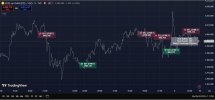
My strategy is currently operating in a sideways market, where price does not show a strong trend either upward or downward, but instead moves back and forth within a defined range. This condition is confirmed by the probability reading on the chart, where Bullish Probability is 38% and Bearish Probability is also 38%, showing that the market has no clear directional dominance. Because of this balance, my strategy focuses more on short-term mean reversion, aiming to sell when price is near the upper boundary of the range and buy when price is near the lower boundary. The most recent signal, which is a STRICT SELL, indicates that price may move slightly lower from its current position, but the confidence of this signal is moderate due to the neutral market state.

Therefore, when executing the trade, my strategy should use tighter stop-loss levels and aim for realistic take-profit targets, generally toward the midpoint or lower side of the range. Therefore, I will manage risk with tight stop-loss placement and realistic take-profit levels, typically targeting the midpoint of the range rather than expecting a strong breakout. For XAUUSD tomorrow, the key price levels to watch are resistance around 4,022 on the upside and support around 3,985 on the downside, with the mid-range level near 4,003 acting as a pivot zone. If price approaches 4,022, I will look for sell opportunities; if price moves down toward 3,985, I will look for buy setups. A confirmed breakout beyond either level, supported by strong momentum, may shift my approach from mean reversion to trend-following.

For XAUUSD tomorrow, the market structure suggests that price may continue to move sideways unless there is a clear breakout supported by strong volume or impactful economic news. If price approaches resistance near the upper range, I will look for sell opportunities, and if it moves down toward support at the lower range, I will look for buy setups. A breakout with strong momentum should be treated cautiously but can shift the strategy from mean-reversion to trend-following if confirmed by sustained price movement.
 

Attachments

  • 2.jpg
    2.jpg
    107.2 KB · Views: 115
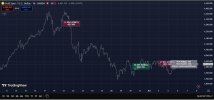
On the 1-hour timeframe, my strategy still recognizes that the market is in a sideways condition, where price movements are not forming a clear upward or downward trend but are oscillating within a stable range. This is supported by the current probability reading of Bullish 16% and Bearish 32%, which indicates that bearish pressure is slightly more dominant, but not strong enough to declare a true downtrend.

Therefore, my strategy remains focused on mean-reversion trading, taking SELL positions near the upper boundary of the range and BUY positions near the lower boundary. The most recent STRICT SELL signal suggests potential downward continuation, but given the weak momentum, I will treat it carefully and aim for moderate, controlled profit targets rather than expecting a deep decline. Key levels to watch on the 1-hour chart are 4,035 to 4,050 as resistance and 3,960 to 3,940 as support, with 4,000 acting as the primary pivot level.

If price moves up and rejects around 4,035–4,050, I will look for a new SELL setup, if price drops toward 3,960–3,940 and shows a reaction, I will prepare for BUY opportunities. Only if price breaks and holds beyond these zones with strong momentum will I shift my approach from mean-reversion to trend-following. In short, on the 1-hour timeframe, my strategy prioritizes patience, precise entry near range edges, and controlled risk rather than aggressive directional positioning.
 

Attachments

  • 3.jpg
    3.jpg
    102.9 KB · Views: 118
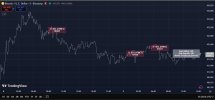
A typical forex strategy uses trend evaluation, key support and resistance zones, and solid risk management. Traders identify market direction, validate entry points with indicators, and place stop-loss and take-profit levels. Steady discipline, controlled exposure, and adjusting to shifting market conditions improve long-term results and help limit emotional trading.
 
Back
Top